
Top Signs You Need Garage Door Service – Don’t Ignore These
A garage door that takes three seconds longer to open than it did six months ago isn’t “getting old” – it’s telling you the springs are losing tension and are probably within weeks of snapping under load. The same goes for a door that shudders on the way down, a squeal that shows up in the same spot every morning, or a bottom gap you keep meaning to look at. Most garage door failures in Port Orange don’t happen without warning. They announce themselves weeks in advance through sounds, speeds, and movements homeowners dismiss as normal aging.
Here’s how to read those signals before a small adjustment turns into an emergency. And if you’d rather not climb a ladder, call us at (877) 735-4535. We answer 24/7.
Key Takeaways
- A door that’s slowing down is a warning, not a personality change. Springs lose tension gradually and then fail suddenly.
- Noise type matters. Grinding, squeaking, and rattling point to three different components.
- The one-foot test tells you in under two minutes whether your springs are balanced or failing.
- Photo-eye sensors are the most misdiagnosed part on any door. Thirty seconds of checking saves a service call.
- Port Orange’s summer heat cycles are harder on opener motors than most homeowners realize.
Why Most Garage Door Failures Give You Notice First
We’ve seen this again and again: the door snapped on a Tuesday, but it had been complaining for a month. Garage doors are mechanical systems with moving parts under real tension, and mechanical systems rarely fail clean. They wear. They loosen. They lose spring tension one coil at a time. The failure feels sudden because that’s the moment you notice – not the moment it started.
That gap between the first symptom and the final failure is your window to act. Miss it and an eighty-dollar adjustment becomes a four-hundred-dollar repair, usually with a car trapped on the wrong side of the door. Catch it and you’re back up and running with a fraction of the fuss.
So what does a door actually sound like when it’s trying to tell you something? Glad you asked.
What Your Door’s Noises Are Actually Telling You
Three sounds mean three different things, and none of them mean “just needs oil.”
- Grinding. Metal-on-metal grinding usually points to worn rollers or a torsion tube that’s shifted in its bearings. It’s a rough, low, constant sound that doesn’t change with speed. Left alone, grinding accelerates wear across the whole track assembly.
- Squeaking. High-pitched squealing at a specific spot in the door’s travel often means dry hinges or rollers, but when it’s paired with a door that hangs up in the same place every time, suspect a misaligned track. Squeaking is the least urgent of the three. It’s also the one people ignore longest, which is how it becomes grinding.
- Rattling or clattering. Loose hardware – hinges, brackets, the opener’s chain or belt. A quick hardware check usually resolves it. On a Genie or LiftMaster chain-drive opener, a rattle that grows louder over weeks can also signal a worn drive gear.
One sound we do not tell homeowners to fix themselves: a loud bang followed by a door that won’t lift. That’s a torsion spring that’s failed. Springs are under extreme tension, and a wrong move around them can cause serious injury. Spring repair done safely is a job for a trained technician, full stop. If you heard that bang in Port Orange, call us – same-day service is what we’re built for.
The One-Foot Test: Check Your Spring Balance in Under Two Minutes
This is the simplest safety check any homeowner can do, and almost nobody does it. Here’s the short version:
- Close the door fully with the opener.
- Pull the manual release cord to disconnect the opener from the door.
- Lift the door about a foot off the ground by hand.
- Let go.
A healthy door stays put – roughly where you left it. A door that slides back down on its own is telling you the springs have lost tension and are working too hard to hold it up. A door that flies up is over-sprung. Either way, the balance is off, and the opener is now doing work the springs should be doing. That’s how openers burn out early.
Do this test any time you suspect a problem, and stop if the door feels unusually heavy or the movement feels jerky. It’s a check, not a repair.
The Uneven Bottom Gap in Port Orange: Hardware or Foundation?
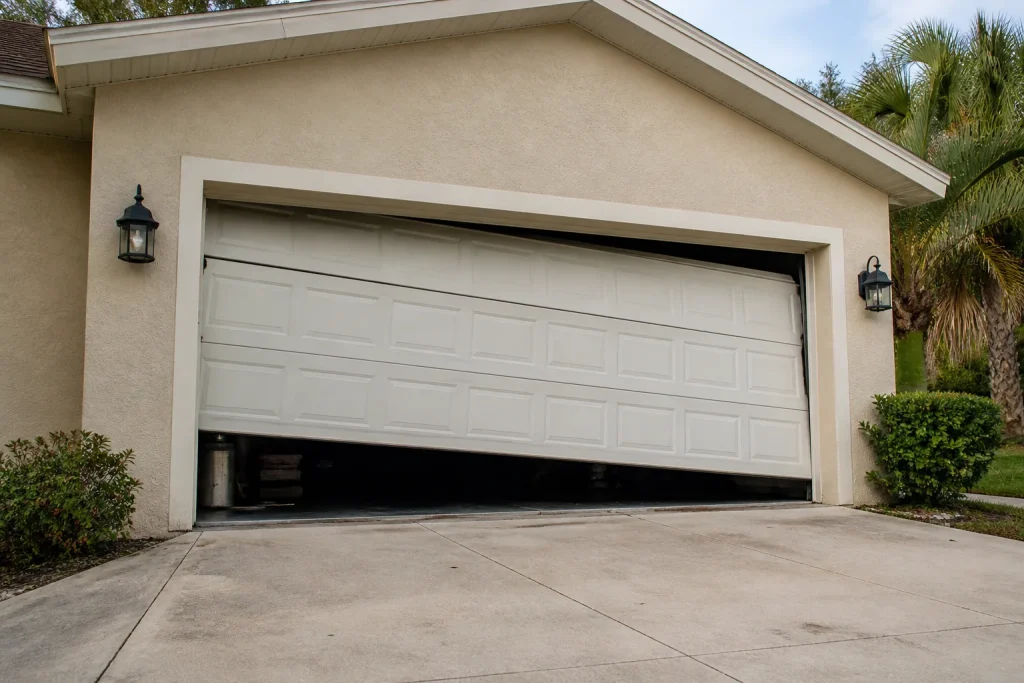
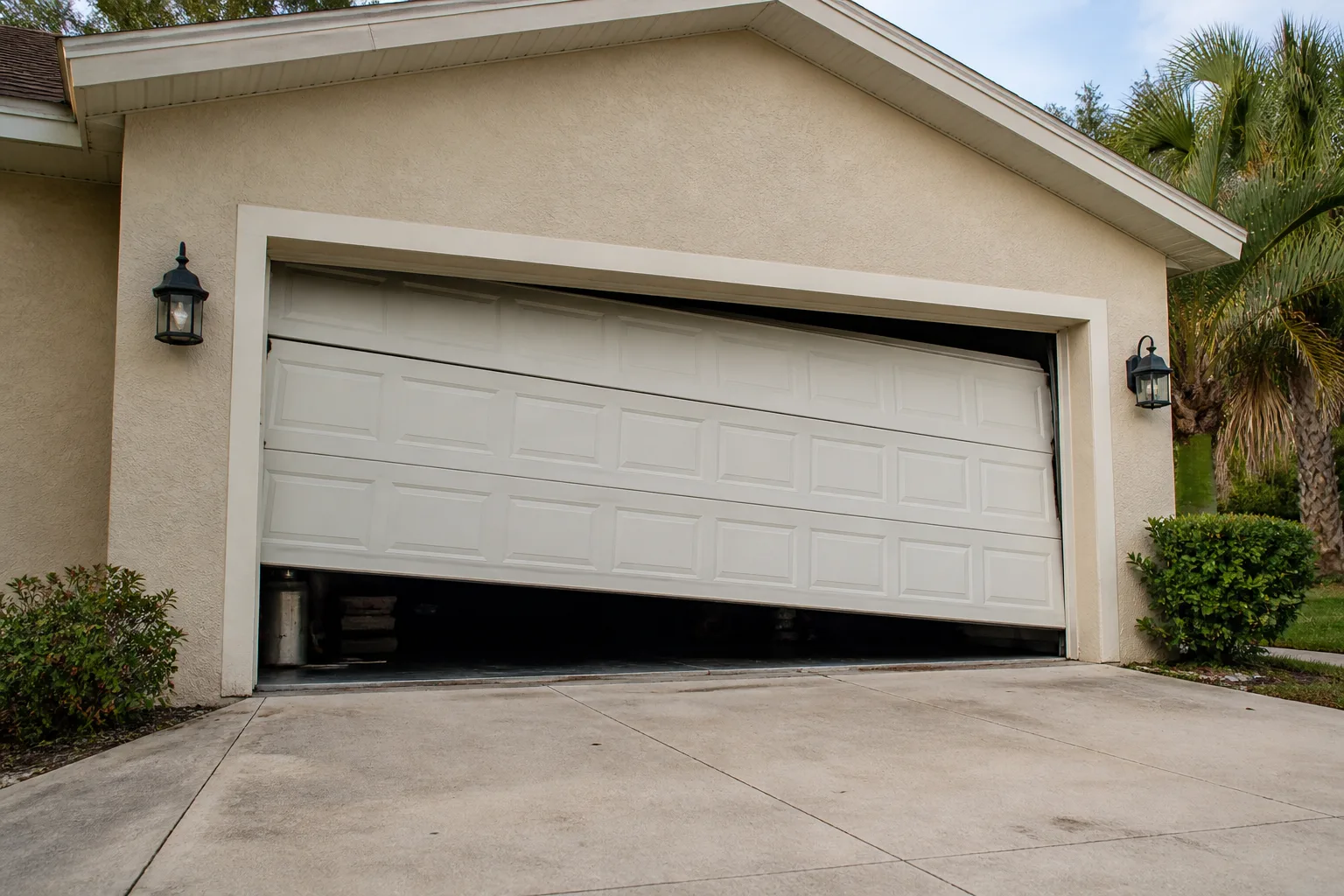
Florida homes have a foundation story, and garage doors hear it first. An uneven gap along the bottom of a closed door – light showing through on one side, tight on the other – is usually one of two things, and telling them apart matters.
If the gap appeared gradually over months and the concrete floor beneath the door looks uneven or has a subtle slope, it’s likely settling. Central Florida’s soil shifts with wet and dry seasons, and garage slabs are not immune. A gap that appears suddenly, or that shows up alongside a door that binds or leans, points to hardware: a bent track, a worn roller, or a torsion tube that’s out of level.
Quick way to tell: look at the door’s travel path. If it moves smoothly but sits unevenly when closed, suspect the floor or the bottom seal. If the door itself drags or tilts, it’s hardware. A Clopay or Amarr door with a good bottom seal can often bridge minor slab variation with a new seal rather than a structural fix. Either way, don’t ignore it – that gap is also the easiest way for water, pests, and Port Orange’s afternoon thunderstorms to find their way in.
Photo-Eye Sensors: The Warning Sign Everyone Blames on the Remote
If your door opens fine but refuses to close, stop blaming the remote. The remote controls opening. The photo-eye sensors – the two small lenses at the base of the track – control closing. When they’re misaligned, dirty, or blocked, the door closes a foot and reverses. Every time.
The 30-second fix: wipe both lenses with a dry cloth and check that nothing is in the beam’s path – a leaf, a spiderweb, a gardening tool, a kid’s scooter. Also check that the small LED on each sensor is solid, not blinking. Blinking means the beam is broken.
Here’s the sign it’s actually sensor failure and not a quick fix: the lenses are clean, aligned, and the LED still blinks, or the door reverses even with nothing in the path. That’s a wiring or sensor issue, and it’s one of the most common calls we get on garage door opener repair. Worth knowing: sensors on Wayne Dalton and Chamberlain openers are wired differently, and a sensor swap without checking the opener’s logic board can leave you with the same problem.
Why Port Orange Heat Stresses Opener Motors
Garage doors get hot here. Central Florida summers push attic and garage temperatures high enough that an opener motor running in a closed garage is doing more work than the same motor in a milder climate. Add the thermal load of repeated open-close cycles and the motor’s internal components age faster than the calendar suggests.
What sluggish reversal behavior signals: if the door starts reversing earlier, or the opener hesitates for a beat before it moves, the motor is struggling. Sometimes it’s a capacitor wearing out. Sometimes it’s the motor’s force settings drifting after months of heat cycling, or a drive gear that’s softened and slipped. Left alone, a hesitant opener becomes a dead opener – often on a morning you can’t afford it.
Our technicians have up to 9 years of experience across every major brand – LiftMaster, Chamberlain, Genie, and the rest. When we show up, we already know your brand’s force settings, its typical failure points, and whether it’s worth a repair or a replacement. We work on your brand, and we’d rather repair than replace.
When to Call a Pro (And What to Check First)
Some things are worth checking yourself: noise from a dry hinge, a sensor that just needs wiping, a manual release cord that needs re-engaging. Some things are not. Springs, cables, and anything involving the torsion assembly are genuinely dangerous – high tension under load and no margin for error. If a door is heavy, uneven, or making a sound like it’s about to fail, stop running it and call for garage door repair.
For springs specifically, our garage door spring repair is a core specialty – the kind of repair that gets mishandled when someone treats it like any other part. We’d rather see one of those than a homeowner on a ladder. And if your door has reached the end of its life, the same team that fixed it yesterday can handle a full installation – no handoff, no runaround.
If you need us today, call (877) 735-4535. We answer 24/7. Fast dispatch from 7am to 7pm, Sunday through Friday, with same-day service on urgent calls.
The Bottom Line
Your garage door is a machine with a voice. Grinding, squeaking, rattling, a door that slides down on its own, a bottom gap that keeps growing, an opener that hesitates before it moves – every one of those is a specific mechanical message, not normal aging. Read them early and you’re looking at a minor adjustment. Ignore them and you’re looking at a snapped spring, a dead motor, or a door that won’t close with your car stuck outside.
If you’re in Port Orange and need help, Port Orange Garage Door Repair Pros offers free estimates – call (877) 735-4535. The price is quoted and agreed before any work starts, every time.
Frequently Asked Questions
The earliest signs are a door that’s slower than it used to be, new or worsening noises during travel, and a door that doesn’t stay in place when lifted a foot by hand. Any of these means the balance or hardware has shifted. Call (877) 735-4535 for a free estimate – estimates are free.
If your door is sluggish, won’t stay in place when lifted manually, or you’ve heard a loud bang followed by a door that won’t lift, the springs are likely failing or already broken. Spring repair is dangerous work that requires a trained technician. Call (877) 735-4535 and we’ll diagnose it safely.
Most of the time, it’s the photo-eye sensors at the base of the track – misaligned, dirty, or blocked by an object. Wipe the lenses and check the LED. If it still reverses with clean, aligned sensors, it’s a sensor or wiring fault. Call (877) 735-4535 for opener repair – same-day service in Port Orange.
Yes. A growing gap is usually foundation settling, a bent track, or a worn bottom seal, and it lets water and pests in. If the door moves smoothly but sits unevenly, it’s likely the floor or seal. If it drags or tilts, it’s hardware. Call (877) 735-4535 and we’ll tell you which it is.
Written by the team at Port Orange Garage Door Repair Pros.
Need Garage Door Help?
Call Port Orange Garage Door Repair Pros - the local pro we connect you with is licensed and insured, here with fast help in Port Orange.
(877) 735-4535